RFP-13: Devcon 8 India Community Hubs 🇮🇳

TL;DR

  • Devcon Community Hubs return for Devcon 8 in Mumbai, November 3–6, 2026.

  • Hubs are physical spaces within the venue where community groups host their own programming — community-driven, educational, and marketing-free.

  • Applications open June 10 and close August 12, 2026, all time zones included.
    UPDATE: Submission deadline extended to August 26, 2026, all time zones included.

  • Submit by replying to this post using the Devcon 8 Community Hubs Proposal Template.

Introduction

Following three successful editions across Bogotá, Bangkok, and Buenos Aires, Community Hubs are back for Devcon 8 India :india:.

Devcon is the Ethereum ecosystem’s annual global gathering — a place to connect, learn, and build a free and open future together. Across four packed days, you’ll dive into open-source technology, meet the communities behind it, and explore the ideas defining what’s next. This year, India is where Ethereum comes to life.

At its heart, Devcon is grounded in Ethereum’s core properties: censorship resistance, open source, privacy, and security. Together, we call them CROPS :ear_of_corn:. Built on these principles, Devcon expands what’s possible by being an open door for explorers, a common ground for builders.

Whether you’re an open-source contributor who champions collective ownership, an advocate fighting for digital privacy and peer-to-peer freedom, a researcher exploring fairer economic models, or someone who builds tools because they should belong to everyone, there is a place for you at Devcon.

Description

Devcon Community Hubs are physical spaces within the main venue that host their own complementary programming. These programs are curated and independently organized by community groups with expertise in the chosen topic.

By designing their own content, these hubs help shape the overall Devcon experience — making it more decentralized, inclusive, and grounded in Ethereum’s community spirit.

Think of them as gathering points that complement the main Devcon program: spaces where attendees can stop by, ask questions, connect across domains with other communities, and explore new portals.

Most importantly, these spaces must not promote any single project or initiative. They remain strictly educational and community-driven, free of branding and marketing.
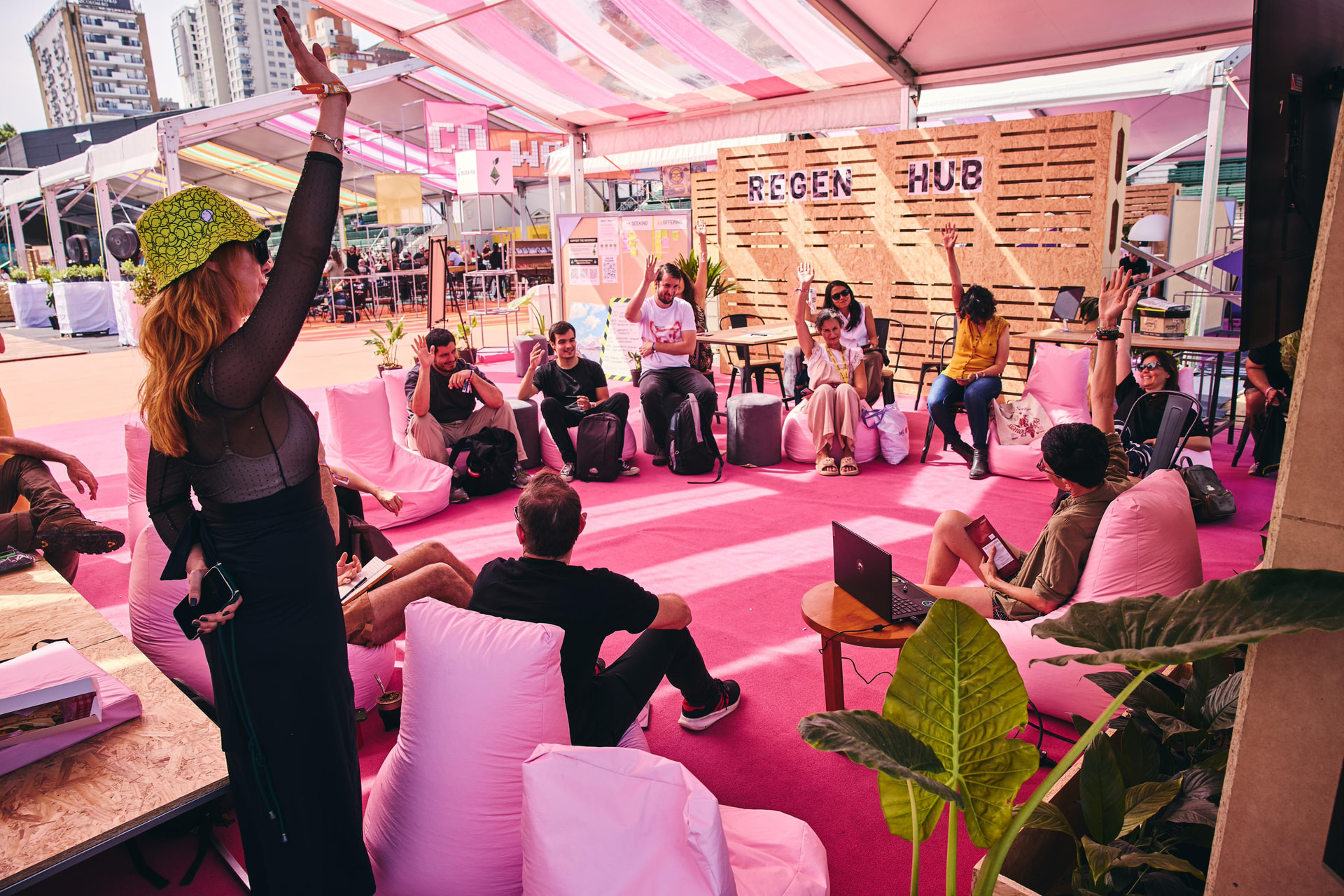
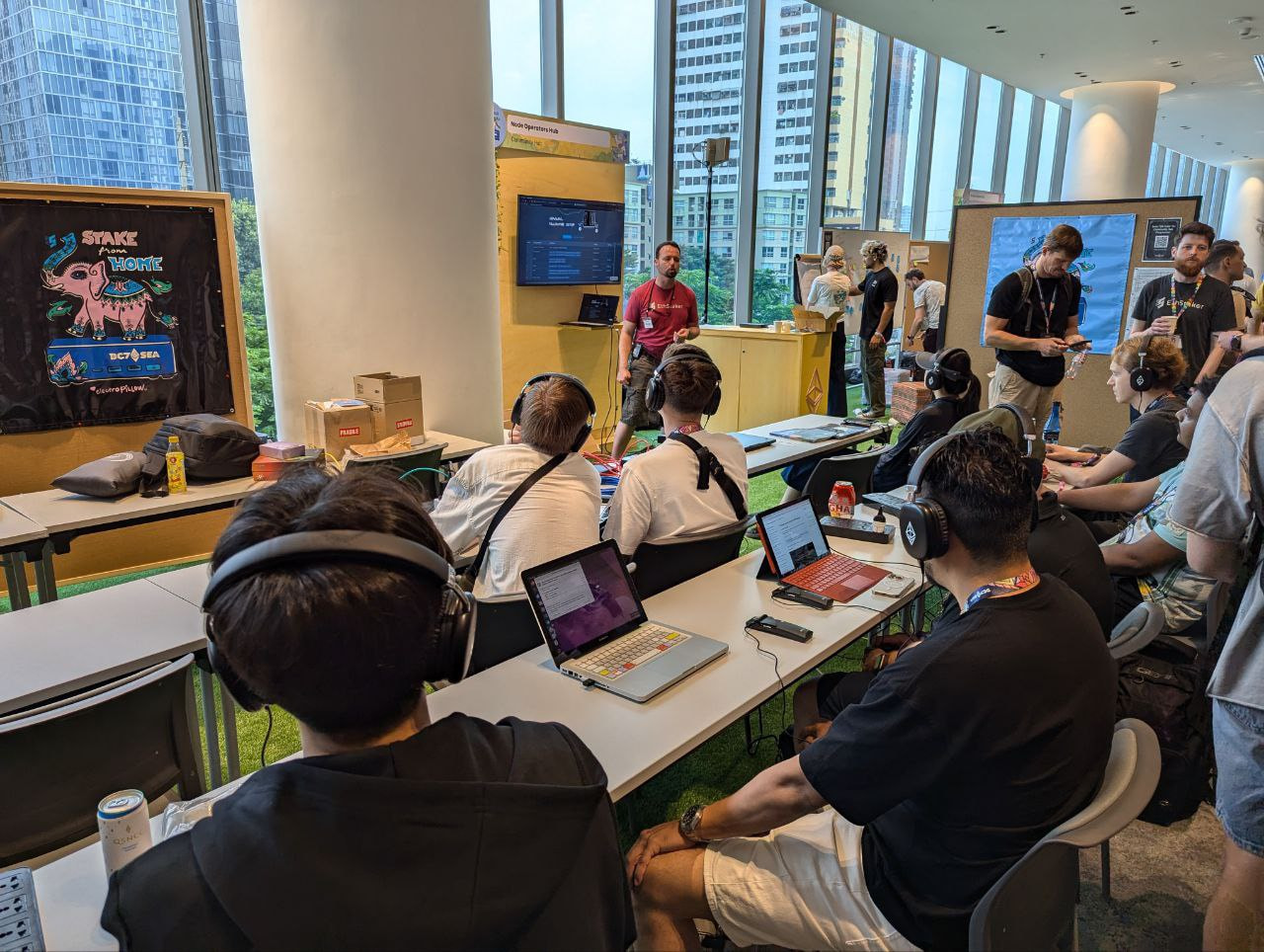
Activities that can take place in Community Hubs include (but are not limited to):

  • Onboarding sessions

  • Discussion roundtables

  • Ideation sessions

  • Workshops

  • User research and feedback sessions

  • Community building activities and cross-pollination

  • Art, games, and creative formats

These are starting points, but it’s up to you, as community builders, to get creative!

The format and approach are open — what matters is that the programming serves the chosen topic and the broader open-source and Ethereum communities.

Background: A Brief History of Community Hubs

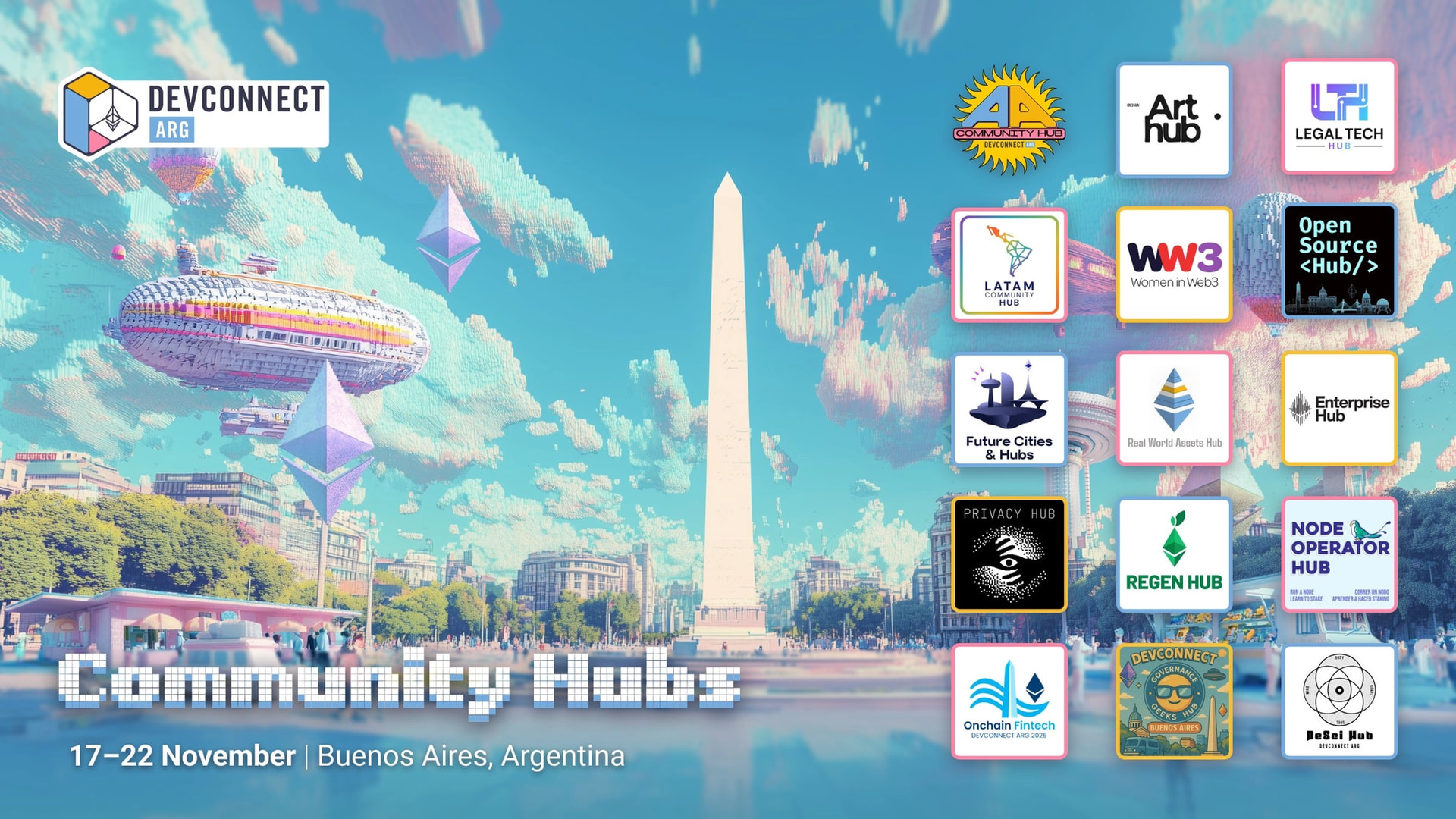
Community Hubs began as a concept for Devcon Bogotá (2022), with 6 pioneer hubs in their first iteration. For Devcon SEA in Bangkok, our RFP attracted such remarkable quality and diversity that the planned 9 hubs expanded to 14.

At Devconnect ARG (2025), Community Hubs grew further with a 15th ‘floating’ Legal Hub organized by Devcon Scholars and law students attending Devcon SEA, integrating their programming and education across other hubs.

With three editions in the books, Community Hubs are now an integral part of the Devcon experience. Their open, interactive, inclusive, and marketing-free format represents the heart of our annual global gathering and the important role of communities. Participants focus on the substance of discussions, with organizers, contributors, and locals engaging in valuable knowledge sessions, workshops, talks, and games — fostering open and long-lasting collaborations.

Check out last year’s Community Hubs here.
Back to the Roots :seedling:

As the Infinite Garden keeps growing, this year it invites us to come back to the source to strengthen the roots that have made it grow.

For Community Hubs, this means three things:

First, clear focus on the core properties of Ethereum: Censorship-Resistance, Open-Source, Privacy, and Security (CROPS) sit at the heart of this year’s request for proposals, and we particularly welcome initiatives from communities working on these topics. In past editions, Node Operators, Open Source, and Privacy Hub have done an incredible job carrying this work forward. This year, we’d love to see a Security Hub join them.

Second, deepening the format itself. Community Hubs have proven to be a vital part of the Devcon experience, and this year we’re taking it one step further with stronger bridges between hubs and the wider Devcon programming. Get ready to take the stage!

Third, an expanding horizon. The Infinite Garden is rich in diversity, with many stewards building towards an open future. This year, Devcon Community Hubs strengthens its core focus while also welcoming a wider range of communities: open source projects, privacy and cryptography researchers, civil liberties defenders, educators and public-interest technologists, builders of resilient local communities, and the quiet maintainers of civilization who keep essential systems and traditions running.

Community Hubs are not only deepening their roots; they’re also welcoming natural allies. Returning hub organizers bring continuity, depth, and experience. Aligned topics and communities bring new perspectives.

This year’s Devcon Community Hubs invite both. It’s time for global communities building a free and open future to connect, collaborate, and grow :seedling:

An Evolving Format

What’s new for Community Hubs this year? As the concept matures, we’re exploring new ways for hubs to participate that build on the strength of the format.

This year, every Community Hub will be invited to take the stage!

Each hub will host its own dedicated stage session — with formats and final details to be defined together with selected hubs in the months leading up to the event. These sessions are an extension of the hub itself, designed to bring its programming and community to a wider Devcon audience.

We’re particularly interested in sessions that bring the audience into the conversation. Workshops, live Q&A formats, audience-driven discussions, roundtables with multiple community voices, live demos with participation — these formats fit the Community Hubs ethos in a way that traditional talks often don’t.

This is an evolution of the Community Hubs format, not a replacement: the hubs themselves remain the heart of the initiative.

Know Before You Apply

What’s expected from Community Hubs?

All Community Hubs must follow the Community Hub guidelines:

  • Should be dedicated to and centered around one specific Ethereum / OSS / CROPS related topic.

  • Must be driven by communities rather than a specific project or company.

  • Must be free of marketing and branding, no shilling of tokens or promotion of specific projects.

  • No fluff, no hype, original and educational content only.

  • Should have a tech-driven approach to building real applications with and for communities.

  • Must offer real value to attendees and be 100% accessible to all Devcon participants.

  • Must be staffed during all event days and opening hours: November 3 - 6, from 9 am to 6 pm (final time frame subject to change).

  • Must attend all onboarding sessions for pre-event coordination.

  • Submit required information in a timely manner.

  • Create or reuse an original logo for the topic of the hub.

  • Organizers need to be available for setup day on November 2.

What will selected Community Hubs receive?

  • A dedicated physical space within the Devcon 8 venue (capacity ~30 people)

  • 10 bean bags / cushions / chairs (specific format and number subject to availability)

  • 1 LED TV screen on a stand + HDMI connection

  • 2 wooden or cork boards

  • 2 whiteboards

  • 1 worktable for up to 6 people

  • Power outlets

  • Small cabinet

  • 1 Ethernet cable (20/20 mbps)

  • Shared storage space for bigger items (to be defined)

  • A limited number of Devcon 8 tickets for the organizing team and engaged contributors

  • Coordination support from the Devcon Community Hubs team

  • Inclusion in official Devcon communications and the Community Hubs program

Additional features will be confirmed closer to the event as detailed logistics are defined.

Beyond these items, community organizers are free to customize the space as they see fit while following the guidelines. However please note, Community Hubs should always complement and support Devcon’s official programming.

Creative Concept

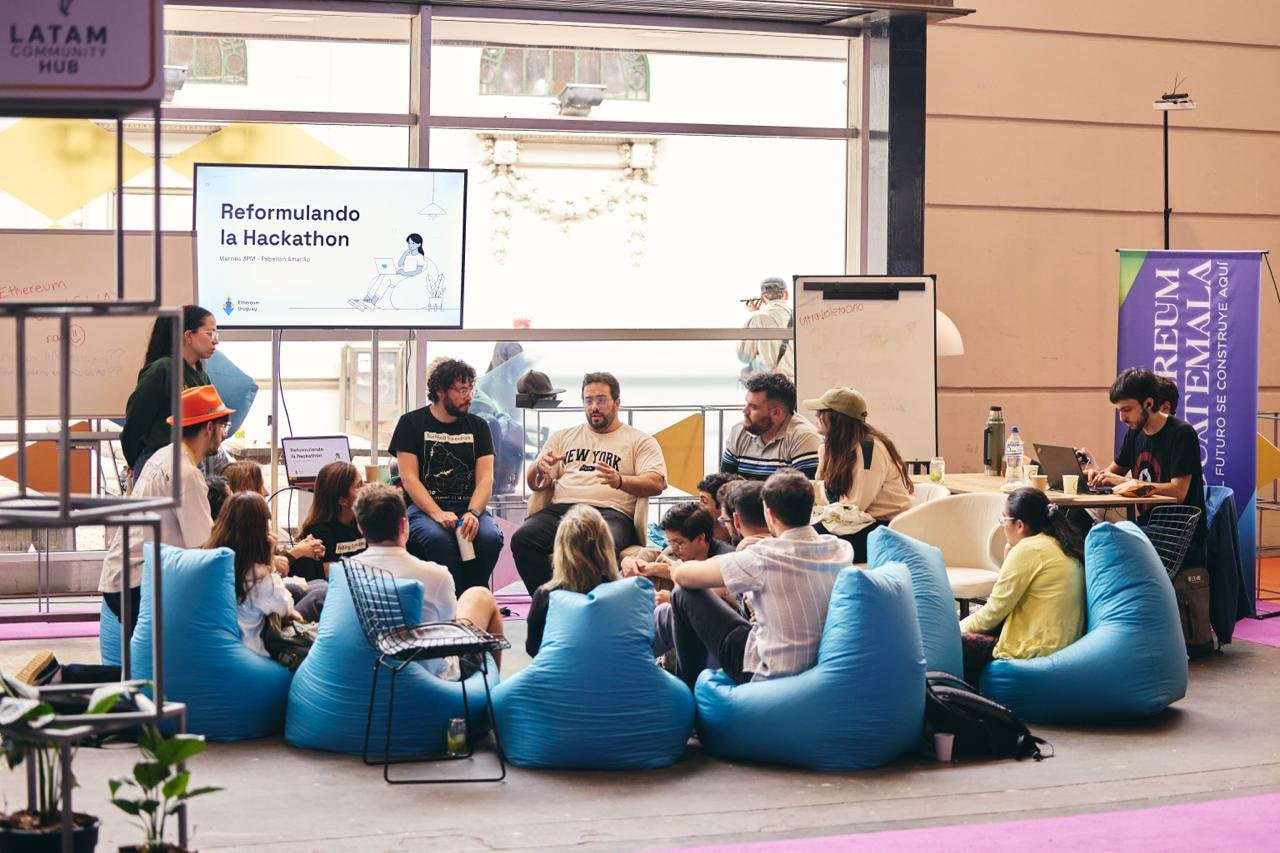
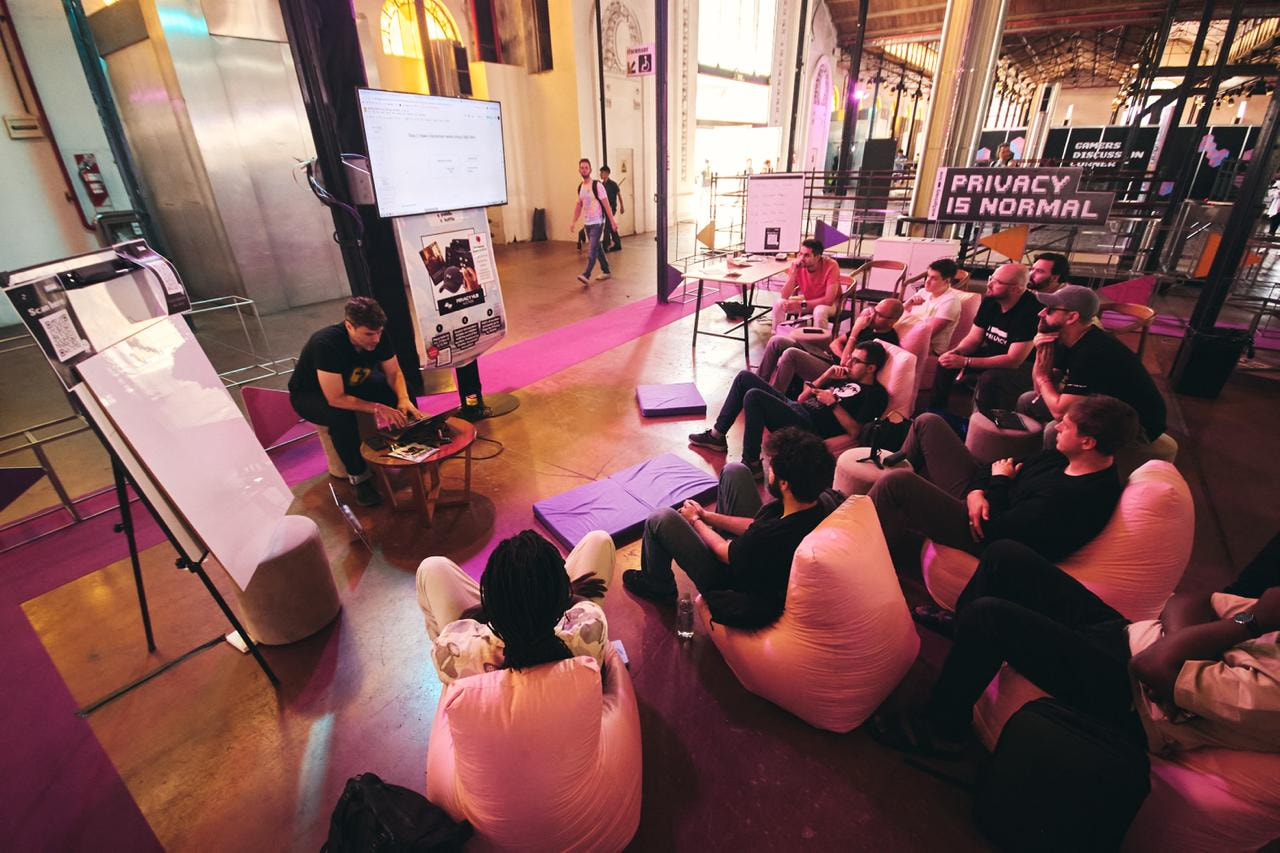
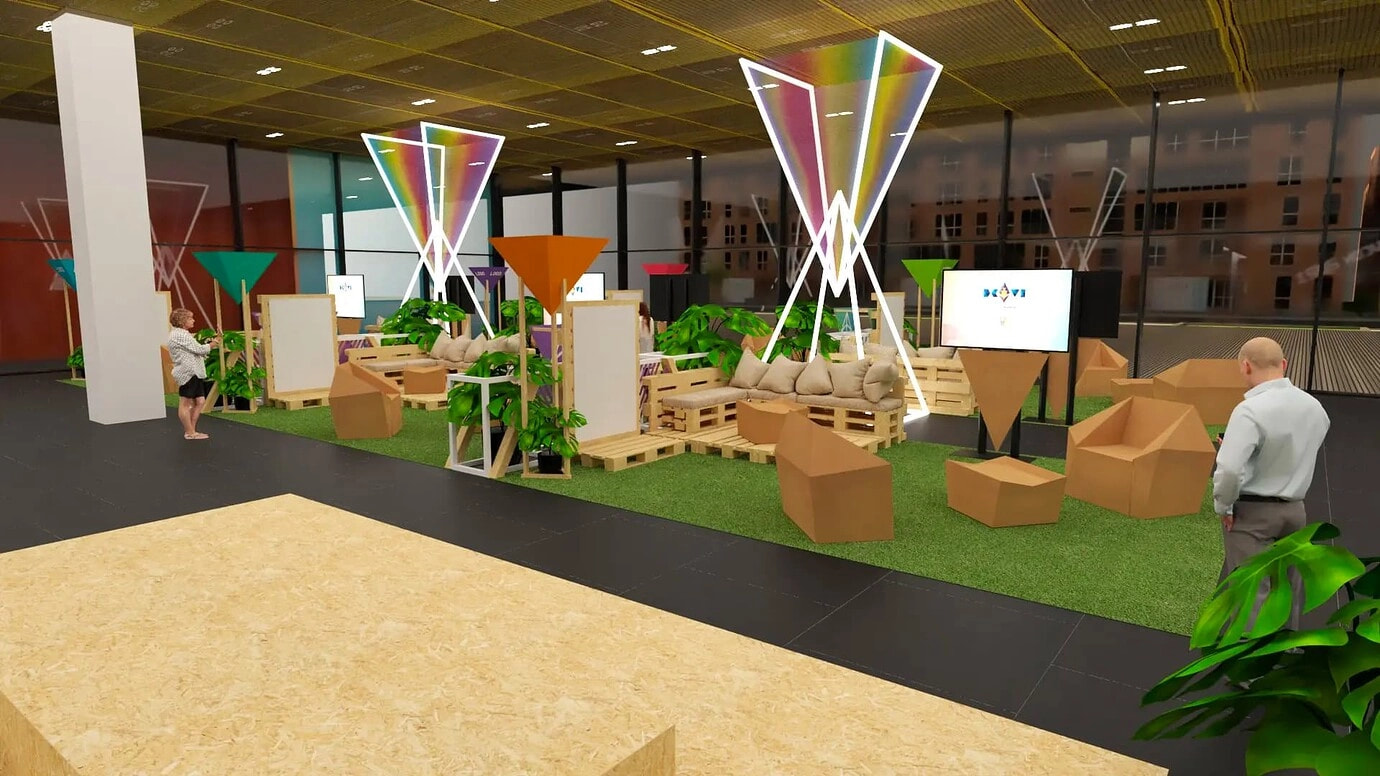
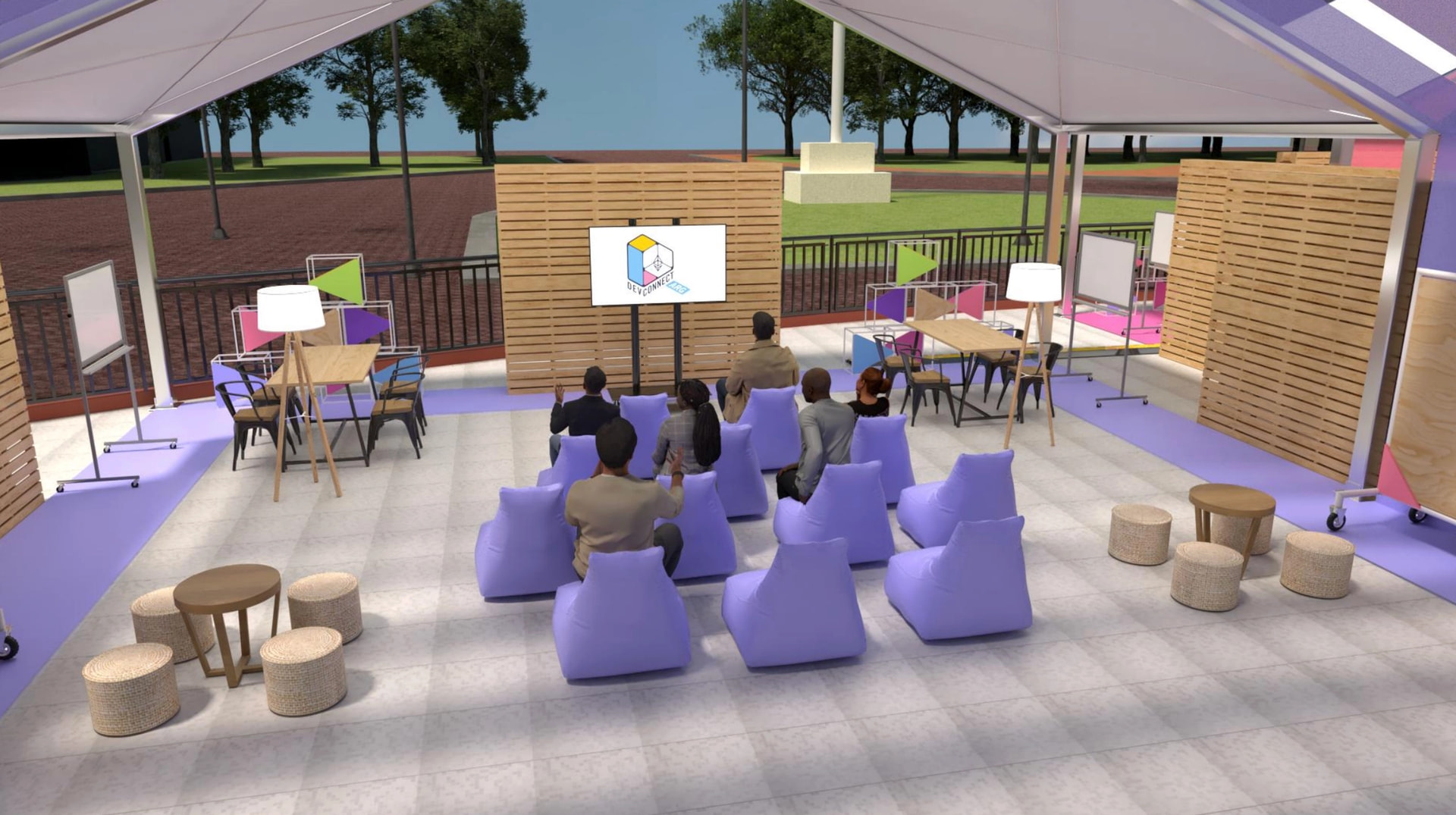
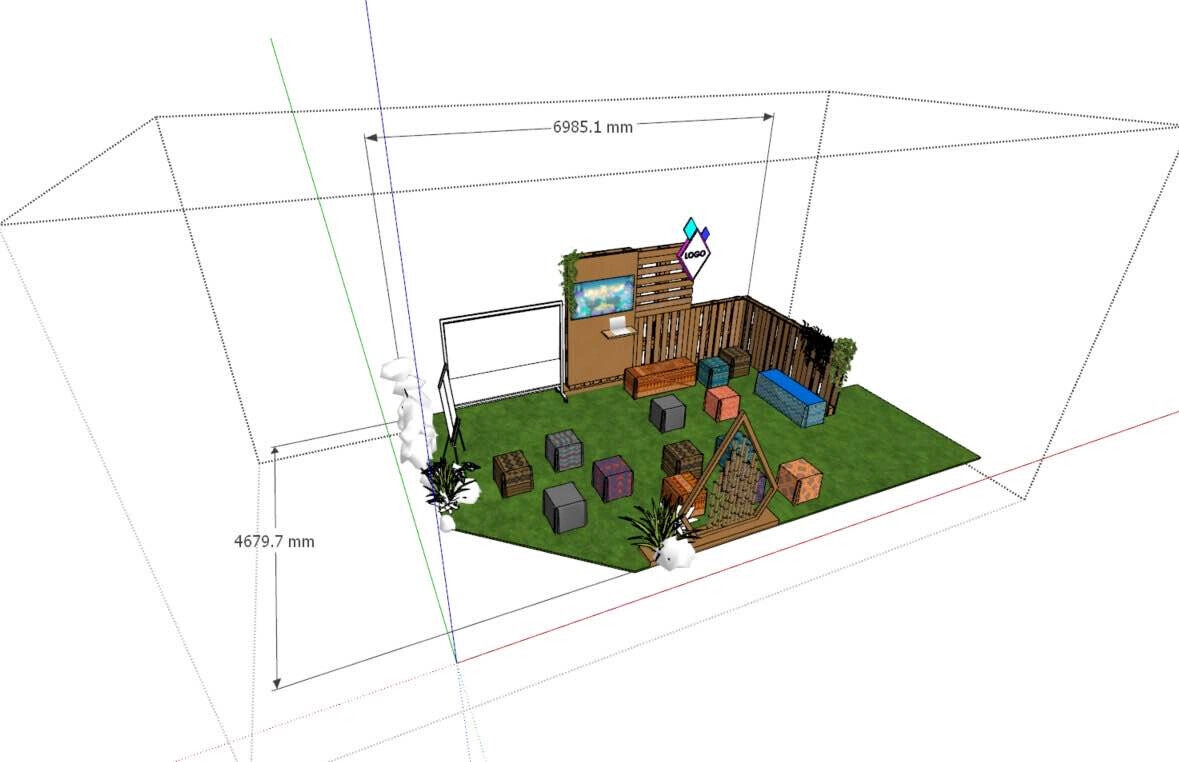
Here are past examples of Community Hubs. Please note that the design and location of each Community Hub are subject to change, but can be used as a reference to visualize how Community Hubs are intended to look.

The space will be around 48 square meters. It considers around 30 people between those sitting and standing.
Submit a Proposal

Submit your proposal using the Devcon 8 Community Hub Proposal Template, and create a new post within the Community Hubs category.

Your proposal should include:

  • Hub name and topic (i.e. Devcon 8 India: Privacy Hub)

  • Description of the communities/coalition behind the proposal

  • Programming plan (formats, sessions, key activities) and possible speakers

  • Core organizing team and their experience

  • How your hub aligns with the principles of Devcon Community Hubs (community-driven, marketing-free, educational)

  • Any special requirements or considerations

Join the Discussion

Even if you don’t have a specific idea to present or won’t be actively organizing a Community Hub yourself, we highly encourage everyone to participate in discussions by sharing their thoughts and feedback on the submitted proposals, as well as on the overall concept and execution of Community Hubs.

To start and get familiar with the process, head over to the Community Hubs category of the forum, and check out the proposals that are already being shared.

Always be mindful of our code of conduct when joining the discussion.

RFP Process and Deadlines

  • The RFP is open until August 12, across all time zones. UPDATE: The RFP is open until August 26, across all time zones.

  • Selected proposals will be announced by the end of August, followed by a collaborative phase to fine-tune each hub’s concept, programming, and production needs.

Timeline [UPDATED August 12]

  • Wednesday, June 10, 2026 — RFP opens

  • August 26, 2026 — Applications close

  • August 27 to September 7 — Internal review and voting

  • September 9 — Selected hubs announced

  • September & October, 2026 — Community Hubs onboarding calls

  • November 2, 2026 — Setup day in Mumbai

  • November 3–6, 2026 — Devcon 8 India

  • Week of November 9 — Retrospective & feedback call

Questions?

For any questions about this RFP or the Community Hubs initiative, please reply to this post, reach out in our Devcon 8 India public chat, or email us at ecosystem@devcon.org.

We look forward to your proposals and to growing this initiative together — back to the roots, and onward to new horizons :seedling:

See you at Devcon 8 India! :india:

7 Likes

Interactive formats fit CROPS topics better than standalone talks. I work on extending that same capture-resistance logic up to the stakeholder layer, where token & incentive design show who actually captures the value a protocol creates. Happy to bring an interactive, participatory format to a relevant hub: Security, governance, or cryptoeconomics. Tag me if you’re forming one

3 Likes

Excited for the amazing hubs being planned during Devcon 8! :smiling_face_with_three_hearts:

2 Likes

Proposal: The CodeCrax Privacy & Decentralized AI Hub

Summary of Proposal

The CodeCrax Privacy & Decentralized AI Hub empowers builders at the intersection of local AI and verifiable privacy. Rooted in Central India’s growing Web3 ecosystem, this hub provides hands-on, collaborative environments for deploying privacy-first AI applications via WebAssembly, integrating EVM chains, and fostering open-source, censorship-resistant collaboration. It acts as a bridge, bringing the grassroots engineering talent of Tier-2 and Tier-3 Indian cities directly into the global Ethereum ecosystem.

Motivation and Rationale

Enhancing the Experience: This Hub shifts attendees from passive listening to active building. It provides a dedicated, high-energy environment for developers to experiment with running local Large Language Models and building privacy-preserving decentralized applications using Ethereum infrastructure.

Complementing Devcon 8 India: While the main stages cover high-level theory, this Hub offers grassroots, deep-tech implementation. It brings the builder-first energy of Central India’s emerging tech hubs directly to the global stage in Mumbai.

Why a Hub format: Building privacy-first AI on blockchain requires continuous troubleshooting, environment setup, and peer-to-peer debugging. A dedicated, multi-day space allows for iterative learning and collaborative pair-programming rather than a rushed 45-minute lecture.

Supporting Builders: CodeCrax has a proven track record of mobilizing developers, having recently hosted the BrahmaX 1.0 National Level Hackathon at BGIEM Jabalpur and the Vercel Zero to Agent build week. We understand how to take builders from idea to prototype, supporting their journey in the open-source Ethereum ecosystem.

Implementation

Production Requirements: We will need reliable, high-speed Wi-Fi, ample power strips for continuous laptop usage (approx. 30-40 builders at a time), a projector/screen for code walkthroughs, and whiteboards for architectural diagramming.

Additional Equipment: The organizing team will bring localized routers to ensure smooth local-network testing for WebAssembly and peer-to-peer communication tools, anticipating potential high-traffic network friction.

Collaborative Ecosystem: Recognizing that a four-day hub is a marathon, we have structured our operations to include “Open Mic / Open Hack” slots. We actively welcome other local Web3 student groups and developer DAOs to step in, co-host specific teardown sessions, and keep the decentralized energy fresh throughout the conference.

Programming

Topics & Focus: Our programming heavily anchors on Devcon’s CROPS ethos, specifically Privacy and Open-Source. Topics will include locally run AI models, EVM chain identity verification, decentralized storage (e.g., IPFS/Swarm) for AI models, and zero-knowledge concepts for secure machine learning classification.

Sample Daily Schedule (Interactive Format, 9:00 AM - 6:00 PM):

09:00 - 10:00: Chai & Node Sync: Onboarding, networking, and setting up local dev environments.

10:00 - 11:30: Interactive Build: “Deploying Local AI with WebAssembly” (Live, follow-along coding session where attendees run their first local model).

11:30 - 13:00: Open Hacking & Architecture Whiteboarding: Attendees split into small groups to integrate what they just built with EVM testnets. Mentors circulate to assist.

13:00 - 14:00: Lunch Break.

14:00 - 15:30: Peer-to-Peer Debugging: “High-TPS EVM Integration” (A collaborative session troubleshooting on-chain identity verification and smart contract interactions).

15:30 - 17:00: Open-Source Case Study Teardown: Deconstructing the code of secure medical screening in Web3. Attendees fork open-source repos to modify and test locally.

17:00 - 18:00: Daily Showcase: Attendees plug in and show the community what they broke, debugged, or built that day.

Audience

Target Audience: Web3 developers, AI engineers curious about decentralization, and university students transitioning into the open-source blockchain ecosystem.

Regional Engagement: We aim to heavily engage tier-2 and tier-3 city developers across India. Our community roots in Madhya Pradesh allow us to bridge the gap between highly talented regional engineering students and the global Ethereum ecosystem, ensuring Devcon’s impact is felt far beyond major metropolitan areas.

Team

Organizers: The hub will be led by Hrithik Soni and Harsh Chuoksey, alongside core members Arpit Bhardwaj, Om Gupta, Jasmeet Haryal, Chetan Barman, and Archit Chirollya.

Expertise: The team brings deep, hands-on experience in the Web3 and decentralized AI space. We have built complex integrations, including OmniMesh (a privacy-first AI writing assistant utilizing WebAssembly) and Medi Predict AI (an ML classification tool for healthcare). Our experience organizing 24-hour hackathons and competing in high-level events—such as the DevSummit finale and Monad Blitz New Delhi—equips us with the logistical resilience to run a smooth, engaging hub.

Neutrality & The Anti-Shill Rule: This space will remain strictly educational. Our past projects (OmniMesh, Medi Predict AI, Gateman AI, etc.) will serve purely as open-source technical case studies to explain underlying code architectures. We enforce a zero-tolerance policy for token shilling, marketing, or commercial promotion.

Languages: To maximize accessibility for the local Indian developer community, our core team will provide mentorship and present content fluently in both English and Hindi.

# Devcon 8 Community Hubs Proposal: MPDAO (Madhya Pradesh DAO)

Hub name and topic

- Hub Name: Devcon 8 India: MPDAO Hub (Madhya Pradesh DAO)

- Topic: Grassroots Ethereum Adoption, Education, and Web3 Onboarding in Tier-2/Tier-3 Cities of India.

Description of the communities/coalition behind the proposal

Madhya Pradesh DAO (MPDAO) is a rapidly growing, grassroots Web3 community dedicated to driving Ethereum education, open-source contribution, and local ecosystem building across the heart of India. Representing developers, researchers, and tech enthusiasts from major regional hubs like Indore, Jabalpur, Bhopal, and Gwalior, MPDAO focuses on empowering builders in Tier-2 and Tier-3 cities who often lack direct access to global Web3 networks.

Our community is built on the core Ethereum properties of CROPS (Censorship-Resistance, Open-Source, Privacy, and Security). We have been actively organizing bootcamps, developer workshops, and hackathons across the state to bridge the gap between local talent and the global Infinite Garden.

As a major milestone leading up to Devcon 8, we are organizing a massive Web3 convergence event in Indore during the 2nd week of August. This event will serve as a strategic launchpad to mobilize regional developers, form project teams, and prepare our local builders to contribute meaningfully to the Ethereum ecosystem in Mumbai this November.

Programming plan (formats, sessions, key activities) and possible speakers

Our hub will serve as an interactive, educational space with a focus on cross-pollination and onboarding. Activities will include:

- Onboarding Regional Builders (Workshop): Hands-on sessions tailored for developers outside major tech hubs on how to make their first open-source contributions to Ethereum.

- CROPS for the Next Billion (Discussion Roundtable): Brainstorming how Censorship-Resistance, Privacy, and Security can solve real-world, local challenges in developing economies.

- “Building Local, Impacting Global” (Ideation Session): A guided brainstorming session for attendees to design decentralized tools (dApps) that serve essential local systems and resilient communities.

- The MPDAO Stage Session (Audience-Driven Q&A): A live, interactive workshop highlighting the journey of Tier-2 builders. We will feature live demos of projects built by MPDAO contributors and open the floor for audience feedback, embodying the Devcon spirit of collective ownership.

- Possible Speakers: Shriyash Soni (MPDAO Core Contributor) alongside other local community leads from the MP region.

Core organizing team and their experience

The MPDAO Core Team is comprised of dedicated community builders, open-source contributors, and Web3 ambassadors who have consistently driven local tech adoption.

- Shriyash Soni: Community Lead & Ecosystem Ambassador (Jabalpur, MP). Experienced in guiding builders from zero-to-one, leading builder challenges, and directing resources for production-ready applications.

- [Add Name Here]: [Add Role Here - e.g. Technical Lead / DevRel]

- [Add Name Here]: [Add Role Here - e.g. Event Coordinator]

Past & Current Events Organized by MPDAO:

- Upcoming: *MPDAO Web3 Convergence - Indore (August, 2nd Week)* - A massive regional gathering to ignite local builders ahead of Devcon 8.

- Current: *Builder Journey to Mastery Program* - Ongoing virtual/hybrid bootcamps guiding developers into the ecosystem.

- Past: *Build On Stellar - Jabalpur (Workshop)* - June 2026

- Past: *v0 Zero to Agent - Jabalpur (Meetup)* - April 2026

- Past: *Chainlink 101: From Data to Privacy with CRE (Meetup)* - February 2026

- Past: *MetaMask Community Builder Night Jabalpur* - February 2026

- Past: *Scroll India Connect - Indore Meetup* - December 2025

How your hub aligns with the principles of Devcon Community Hubs

MPDAO operates strictly as a community-driven, public-good organization. Our hub will be 100% free of marketing, branding, and token shilling. Our primary objective is deeply educational: providing a welcoming, highly accessible space for attendees to learn about Ethereum’s CROPS principles. We aim to demonstrate how nurturing grassroots communities in regional areas can foster long-lasting, global open-source collaboration.

Any special requirements or considerations

- Standard Community Hub setup (capacity ~30 people).

- 2 whiteboards for live ideation and architecture mapping.

- 1 LED TV screen + HDMI for showcasing open-source code and educational slide decks.

- We welcome collaboration with other regional DAOs (e.g., from other Indian states) to host joint cross-pollination sessions at our hub.

Links & Resources

- Community Portal / Website: https://www.mpdao.site/

- Twitter / X: https://x.com/mpdao\_

- Telegram / Discord: https://t.me/mp_dao

- Event Photos & Recap (Proof of Work): Notion

Devcon 8 Community Hubs Proposal: MPDAO (Madhya Pradesh DAO)

Hub name and topic

  • Hub Name: Devcon 8 India: MPDAO Hub (Madhya Pradesh DAO)
  • Topic: Grassroots Ethereum Adoption, Education, and Web3 Onboarding in Tier-2/Tier-3 Cities of India.

Description of the communities/coalition behind the proposal
Madhya Pradesh DAO (MPDAO) is a rapidly growing, grassroots Web3 community dedicated to driving Ethereum education, open-source contribution, and local ecosystem building across the heart of India. Representing developers, researchers, and tech enthusiasts from major regional hubs like Indore, Jabalpur, Bhopal, and Gwalior, MPDAO focuses on empowering builders in Tier-2 and Tier-3 cities who often lack direct access to global Web3 networks.

Our community is built on the core Ethereum properties of CROPS (Censorship-Resistance, Open-Source, Privacy, and Security). We have been actively organizing bootcamps, developer workshops, and hackathons across the state to bridge the gap between local talent and the global Infinite Garden.

As a major milestone leading up to Devcon 8, we are organizing a massive Web3 convergence event in Indore during the 2nd week of August. This event will serve as a strategic launchpad to mobilize regional developers, form project teams, and prepare our local builders to contribute meaningfully to the Ethereum ecosystem in Mumbai this November.

Programming plan (formats, sessions, key activities) and possible speakers
Our hub will serve as an interactive, educational space with a focus on cross-pollination and onboarding. Activities will include:

  • Onboarding Regional Builders (Workshop): Hands-on sessions tailored for developers outside major tech hubs on how to make their first open-source contributions to Ethereum.
  • CROPS for the Next Billion (Discussion Roundtable): Brainstorming how Censorship-Resistance, Privacy, and Security can solve real-world, local challenges in developing economies.
  • “Building Local, Impacting Global” (Ideation Session): A guided brainstorming session for attendees to design decentralized tools (dApps) that serve essential local systems and resilient communities.
  • The MPDAO Stage Session (Audience-Driven Q&A): A live, interactive workshop highlighting the journey of Tier-2 builders. We will feature live demos of projects built by MPDAO contributors and open the floor for audience feedback, embodying the Devcon spirit of collective ownership.
  • Possible Speakers: Shriyash Soni (MPDAO Core Contributor) alongside other local community leads from the MP region.

Core organizing team and their experience
The MPDAO Core Team is comprised of dedicated community builders, open-source contributors, and Web3 ambassadors who have consistently driven local tech adoption.

  • Shriyash Soni: Community Lead & Ecosystem Ambassador (Jabalpur, MP). Experienced in guiding builders from zero-to-one, leading builder challenges, and directing resources for production-ready applications.
  • [Add Name Here]: [Add Role Here - e.g. Technical Lead / DevRel]
  • [Add Name Here]: [Add Role Here - e.g. Event Coordinator]

Past & Current Events Organized by MPDAO:

  • Upcoming: MPDAO Web3 Convergence - Indore (August, 2nd Week) - A massive regional gathering to ignite local builders ahead of Devcon 8.
  • Current: Builder Journey to Mastery Program - Ongoing virtual/hybrid bootcamps guiding developers into the ecosystem.
  • Past: Build On Stellar - Jabalpur (Workshop) - June 2026
  • Past: v0 Zero to Agent - Jabalpur (Meetup) - April 2026
  • Past: Chainlink 101: From Data to Privacy with CRE (Meetup) - February 2026
  • Past: MetaMask Community Builder Night Jabalpur - February 2026
  • Past: Scroll India Connect - Indore Meetup - December 2025

How your hub aligns with the principles of Devcon Community Hubs
MPDAO operates strictly as a community-driven, public-good organization. Our hub will be 100% free of marketing, branding, and token shilling. Our primary objective is deeply educational: providing a welcoming, highly accessible space for attendees to learn about Ethereum’s CROPS principles. We aim to demonstrate how nurturing grassroots communities in regional areas can foster long-lasting, global open-source collaboration.

Any special requirements or considerations

  • Standard Community Hub setup (capacity ~30 people).
  • 2 whiteboards for live ideation and architecture mapping.
  • 1 LED TV screen + HDMI for showcasing open-source code and educational slide decks.
  • We welcome collaboration with other regional DAOs (e.g., from other Indian states) to host joint cross-pollination sessions at our hub.

Links & Resources

no Security Hub formed yet that I can see. I work on PQC/cryptographic transition readiness for Ethereum, could pair well with your capture-resistance angle. Open to co-organizing or contributing a session if one forms — what are you thinking?

1 Like

Hello @hrithik @mp_dao @shriyash_soni Thank you for your interest in Devcon Community Hubs.

A kind reminder that proposals need to be posted in the Community Hubs category and follow the Community Hubs proposal template and guidelines.

Thank you!

Hey! I already applied for a Token Rights Hub → Token Rights Community Hub - Devcon 8 Mumbai, India if it’s in your lane, DM me

Please give a short description of the topic/cause for your Community Hub

The Self-Custody & OpSec Hub is a community-led space focused on helping Ethereum users, developers, DAO contributors, and teams use wallets and smart contracts more safely. Through practical, vendor-neutral education, the hub will cover secure key management, transaction verification, token approvals, phishing and wallet-drainer risks, multisig, smart accounts, recovery planning, privacy, and operational security across the Ethereum ecosystem

What will you offer to the Devcon attendees?

We will offer Devcon attendees a community-led, vendor-neutral space to learn and practise self-custody and operational security within the Ethereum ecosystem. Through hands-on workshops, demonstrations, discussions, and walk-in clinics, participants will learn how to safely use Ethereum wallets and dApps, verify transactions, manage token approvals, recognise phishing and wallet-drainer risks, use multisig and smart accounts, improve privacy, and plan for secure recovery. The hub will also provide a space for Ethereum users, developers, DAO contributors, and security practitioners to share experiences and learn from one another.

Rough Program Outline

The hub will run across all four days of Devcon as a practical learning space focused on self-custody and operational security within the Ethereum ecosystem.

Day 1 — Ethereum Self-Custody Foundations
Understanding externally owned accounts, smart contract wallets, seed phrases, private keys, hardware wallets, and the security trade-offs between different Ethereum account models. Attendees will build a personal threat model based on loss, theft, phishing, coercion, device compromise, and recovery needs.

Day 2 — Safe Ethereum Transactions and dApp Interaction
Hands-on sessions on reading transaction prompts, verifying addresses and contract interactions, understanding token approvals, avoiding blind signing, identifying malicious signatures, and reducing exposure to phishing sites, wallet drainers, and compromised front ends.

Day 3 — Smart Accounts, Multisig and Recovery
Practical workshops on Safe and other smart-account models, multisig operational procedures, signer separation, access control, social and institutional recovery, inheritance planning, and designing custody systems without a single point of failure.

Day 4 — Ethereum Privacy, Treasury Security and Incident Response
Sessions on wallet separation, address reuse, metadata leakage, RPC and interface privacy, operational security for DAOs and protocol teams, treasury transaction procedures, emergency response, approval revocation, and recovery after a suspected compromise.

List the people who will organise, oversee and be responsible for the Community Hub

  • Bala & Santosh - Ethereum Wallet Security

  • AD - Smart Accounts and Multisig

  • Palash - Privacy and OpSec

  • Paco - Program Coordinator

List the equipment or production needs (see what’s possible in the RFP)

  • LED TV with HDMI connection for demonstrations

  • Two whiteboards for threat-modelling exercises

  • One worktable for wallet and backup demonstrations

  • Power outlets and extension boards for test devices

Hub name: The Educators’ Hub: Teaching Ethereum Across Audiences

Topic: Blockchain education and literacy (the craft of teaching, across audiences, regions, and languages)

Applicants: Shayan Eskandari and Zuzanna Dziedzic


Summary of Proposal

A hub by and for blockchain educators. We gather teachers who reach very different audiences, from developers to business students to the general public, across languages and regions, to existing approaches to the blockchain education, courses real impact on learners.
Expect open sessions, honest reviews of real courses, and a shared record pointing toward a future conference presentation/paper on blockchain education.


Motivation and Rationale

Blockchain education and building public awareness is happening everywhere at once, but the people doing it rarely compare notes. A university instructor teaching engineers, a business school running a founders’ course, a community organizer onboarding a small town in its own language, and a self-taught educator reaching thousands online all face the same problem from different angles: how do you make this material land for the person in front of you. Most of what works is tacit and scattered. This hub exists to make it visible and shared.

That is also why a hub fits better than a talk or workshop. The value here is comparative and cumulative. One educator’s method only means something next to another’s, and the insights only add up when the room keeps building on them through the day. A hub lets us run short teach-backs with the academia and industry fostering knowledge sharing and building upon experience of all involved co-creating old and co-creating new approches.

A hub focused on the craft of teaching, rather than on a single fixed curriculum, fits this vision directly. It also extends NOVA SBE’s mission, which we put into practice every day through projects such as Blockchain.PT and initiatives supported by the Ripple Impact Fund: democratizing blockchain literacy beyond the usual centers of expertise.

Everything we produce stays open, in keeping with open source. Our own program is free and published openly at blockchainacademy.online, and this hub applies the same principle to teaching itself. We attended past Devcon hubs as participants; the ones that worked had a clear rhythm and a low barrier to contribute, and we are designing around that.


Open Collaboration

This hub is a community effort, not a closed program. We are actively open to collaborating with other educational institutions, community programs, and individual educators who want to take part, co-run sessions, or bring their own teaching experience into the room. The goal is shared: to gather insights into how blockchain education is approached, the challenges people run into, and the practices that actually work, and to keep that record openly available afterward. If you teach this material in any context and want to be part of it, we want you involved. Institutions and educators interested in collaborating can reach us before or during the event.


Implementation

Devcon’s standard hub setup (LED screen with HDMI, seating for around thirty, whiteboards and cork boards, a work table, power, and Ethernet) covers most of what we need. The additions below are things we will source ourselves.

Facilitation kit: sticky notes, markers, and printed prompt cards for the open discussions and teach-back sessions. We run these formats regularly and will bring our own materials.

Live knowledge base: a shared document and repository that we maintain throughout the event, capturing insights, methods, and honest post-mortems from each session. This becomes the artifact that outlives the event and feeds toward a future conference on blockchain education (see Programming).

Optional light capture: with consent, we would like to record the stage session and selected discussions to build that knowledge base. We will bring our own recording setup and will not rely on Devcon production for it.


Programming

Our structured program runs as a single full day (09:00 to 18:00) inside the hub, moving through the full range of teaching contexts in one arc rather than spreading thin. Sessions are deliberately short and interactive, with the longer blocks given to open discussion and hands-on time rather than presentations. The space itself stays open and staffed for drop-in discussion, collaboration, and continued capture of insights (see Open Collaboration).

Single-day agenda (09:00 to 18:00)

  • 09:00 to 09:45, Educator check-in. Coffee and a round of who is in the room and what they teach, across every audience type.

  • 09:45 to 11:00, Teaching technical audiences. A teach-back and short workshop on reaching engineers and security-minded learners. Draws on graduate level teaching, the online developer courses, and smart contract security education.

  • 11:00 to 12:15, Teaching non-technical audiences. A teach-back and discussion on reaching business students, founders, and professionals. Draws on NOVA SBE and the Blockchain Academy’s open-enrollment cohorts.

  • 12:15 to 13:15, Open lunch and informal exchange.

  • 13:15 to 14:30, Multicultural environment teaching approaches across regions and languages. Reaching smaller cities, different languages, and communities the field usually skips, including teaching under real-world constraints. Draws on the Farsi-language work and the Academy’s move into the Portuguese interior (Covilha, Beira Interior). Directly relevant to India’s regional and linguistic diversity.

  • 14:30 to 15:30, Onboarding block. Newcomers are welcomed in and educators practice their approaches on real first-time learners.

  • 15:30 to 16:30, Teaching the teachers. Training new and future educators, with a fishbowl on what works and what fails across all of the day’s contexts.

  • 16:30 to 17:15, Synthesis. We pull the day’s insights into a shared, open record aimed at a future conference on blockchain education.

  • 17:15 to 18:00, Networking and next steps for collaborators.

Stage session: We would run an interactive “teach the same concept, three ways” session. Educators from different contexts each teach one shared concept to the Devcon audience in a few minutes, and the audience then discusses what landed and why. It puts the hub’s whole thesis on stage in a format that is participatory rather than a presentation.

Potential speakers and educators

  • Confirmed: Shayan Eskandari and Zuzanna Dziedzic.

  • Target and invited: educators from India’s Ethereum community and student groups (see Audience), colleagues from the IEEE Blockchain Confluence network (India and Lisbon, 2025), Blockchain Academy and BLOCKCHAIN.PT collaborators, and community educators reaching non-English audiences.

We want a deliberately diverse set of educators in the room: experienced instructors, people who just started teaching, and people who are about to. That mix is the point of the hub.


Audience

Who this is for. Blockchain educators and aspiring educators of every kind: university instructors, bootcamp and academy leaders, community organizers, DevRel and developer advocates, content creators, and translators of technical material. Alongside them, we want curious newcomers in the room during the daily onboarding blocks, because they are who educators learn to teach.

How we engage India’s Ethereum community. We are based in Lisbon, so connecting with the local community is a priority we are planning for directly rather than assuming. Our starting points:

  • Former students. A number of people who took the smart contract auditing and development courses are now active in India’s ecosystem. We will reach out ahead of the event and invite them to co-run sessions.

  • Local educators first. We will reserve featured teach-back slots specifically for Indian educators and student communities, so the hub reflects local teaching practice and is not just international voices talking about India.

Multilingual capability. Between the two of us we can facilitate and produce material in English, Portuguese, Farsi, French, and Polish. The regions and languages block lean into exactly this, and we will actively bring in educators working in Hindi and other Indian languages.


Team

  • Shayan Eskandari. Independent security researcher and educator, based in Lisbon. PhD in information systems security, with a master’s on Bitcoin usability and human-centered security. Instructor at the Blockchain Academy (NOVA SBE and Universidade da Beira Interior, part of BLOCKCHAIN.PT), teaching Blockchain Fundamentals, Blockchain Platforms, and Business Applications of Smart Contracts. Also teaches at NOVA SBE in the fall to a business school audience. Ran free Farsi-language blockchain and smart contract courses through CoinIran Academy across two editions, reaching a wide range of ages and backgrounds, and supervised the instructor team. Teaching assistant for Concordia University’s graduate blockchain course (INSE 6615) and guest lecturer at the University of Ottawa. Professional background includes 50 or more smart contract audits and a lead auditor role at ConsenSys Diligence, which anchors the technical and security education side.
  • Zuzanna Dziedzic, is a Project and Programme Manager with over 10 years of experience leading international initiatives in development, innovation, and education, from project design through implementation and delivery. Her expertise spans complex, multi-stakeholder projects funded under frameworks such as EuropeAid framework contracts, UNDP, Horizon 2020, Innovate UK, EUROSTARS, and Erasmus+. Zuzanna holds a Master’s degree in Political Science and a Postgraduate Diploma in Humanitarian Action. She is a PMP®-certified professional, a certified trainer specializing in gender equality, and holds a Certificate in Monitoring and Evaluation (Results-Based Management) from the International Training Centre of the ILO (ITCILO). Her work is grounded in strong expertise in quality assurance, monitoring and evaluation, and results-based management. She serves as Programme Coordinator of the Blockchain.pt (PRR) initiative at NOVA School of Business and Economics, implemented under Portugal’s Recovery and Resilience Plan (PRR), and leads a further initiative under the Ripple Impact Fund grant, also at NOVA SBE — within which she led the design of the Blockchain Academy programme and developed its training materials, with a specific focus on project management inputs for blockchain initiatives. As a trainer and educator, she is a certified specialist in gender equality and holds a Certificate of Pedagogical Competences (IEFP), having delivered training internationally on topics including project management, transversal skills frameworks for VET teachers, work in multicultural contexts, and participatory and gamification-based learning methods across Europe. She is fluent in Polish, English, and Portuguese, with French at an intermediate level.

Why the space stays neutral and marketing-free. Our entire track record is open and non-commercial. The Blockchain Academy is free, and all of its content is published openly in English and Portuguese. We teach concepts and the craft of teaching them, not products, and we do not promote tokens or projects. That is not a constraint we are accepting for this hub, it is how we already work. Everything produced in the hub will be shared openly on the same basis.

Thank you.

Hello @BitAsha and @root :waving_hand: Thank you for your interest in Devcon Community Hubs.

A kind reminder that proposals need to be posted in the Community Hubs category and follow the Community Hubs proposal template and guidelines.

This will ensure your proposal is officially considered, has a dedicated discussion thread and proper visibility.

Thank you!

1 Like

Summary of Proposal

The Open Science Agents Hub is a four-day, hands-on program where builders create transparent AI tools for scientific discovery. Participants will build an evidence-grounded research agent and a drug-repurposing agent using open data, inspect sources and decisions, test failure modes, and publish reusable open-source workflows for accessible, reproducible, verifiable science.

Motivation and Rationale

  • How would this Community Hub enhance the attendee experience?

Over four days, someone with no prior agent experience can walk out with two working open-source agents on their own laptop: an evidence-grounded research agent and an auditable drug-repurposing agent. They also leave with the run manifests, evidence tables, and red-team notes that make those agents trustworthy. It turns a spectator experience into a builder one, and gives people a concrete tool they can keep contributing to after Devcon.

  • How would it complement Devcon 8 India? In what ways does it add a unique piece to the overall experience?

Devcon 8 in Mumbai is Ethereum’s flagship gathering for a free, open, and verifiable future, and DeSci is one of the clearest places those values meet the real world. This Hub brings a working, hands-on DeSci track to the floor. Not a pitch about decentralized science, but the actual tooling: agents that link every claim to an inspectable source, produce reproducible run manifests, and treat verifiability as a build requirement. It bridges the Ethereum builder crowd and the scientific and bioinformatics community, and gives India’s large developer and life-sciences talent pool a direct on-ramp into open science.

  • Why is this topic significant, and why is a Community Hub the best format to address it instead of a one-time talk or workshop?

Scientific AI is moving fast, and most of it still sits behind closed models, unlinked claims, and results no one can reproduce. That is exactly the failure mode Ethereum’s culture of open source and verifiability resists. A four-day Hub gives us room to build in the open, red-team our own work, onboard newcomers, and hand off maintainable repositories and workshop material that outlive the event.

  • Devcon is the global Ethereum gathering for builders of a free, open, private, and verifiable future. How would this Devcon Community Hub support builders and their journey?

    • Free to attend

    • Code will be published in a public repository

    • Original workshop material will remain publicly reusable

    • Every agent output will link its claims to inspectable sources. Participants will generate evidence tables and run manifests recording the sources, queries, timestamps, model and code versions, configuration, and relevant artifacts used during a run.

    • The workshops will also cover data minimization, secret handling, prompt injection, poisoned or retracted sources, fabricated citations, dependency risks, unsafe tool permissions, and the importance of keeping sensitive patient or unpublished research data out of third-party systems.

  • Have you organized a Community Hub at a past Devcon edition? What have you learned? What would you carry forward or change?

This is our first Devcon Community Hub. Our team has run a multi-track hackathon, both virtual and onsite, supported by partners including Solana and Prime Intellect, so we come in with practical experience running hands-on builder programming, managing mentors and help desks, and keeping newcomers from getting stranded.

Programming - Sample Schedule (9am to 6pm)

  • Please provide a list of possible speakers and topics.

    • Geeve - Drug-Repurposing and Scientific Program Lead: Biomedical framing, disease-target evidence, molecular-data interpretation, candidate ranking, scientific limitations, and evaluation.

    • Chaitanya - Building a State-of-the-art bioinformatics CLI

    • Johannes - Open Science and Community Lead: Open-science practices, community facilitation, scientific-review coordination, and post-event continuity.

    • Ritvik - Research Agent Technical Lead: Research-agent architecture, literature-source integrations, evidence extraction, reviewer agents, hypothesis generation, and reproducible run manifests.

    • Marten - Head of Engineering

Time Days 1 & 3: Evidence-Grounded Research Agent Days 2 & 4: Auditable Drug-Repurposing Agent
09:00–10:00 Welcome, onboarding, and trustworthy scientific AI Welcome, biomedical framing, and safety boundaries
10:00–11:00 Research-agent architecture and open literature sources Drug-repurposing architecture and open biomedical data
11:00–13:00 Guided build: literature retrieval and evidence extraction Guided build: disease to targets to compounds
13:00–14:00 Networking, help desk, and newcomer onboarding Networking, help desk, and newcomer onboarding
14:00–15:30 Hypothesis generation and reviewer agents Molecular properties and evidence-aware ranking
15:30–16:30 Scientific-agent red-team clinic Scientific review and failure analysis
16:30–17:30 Open build clinic and advanced extensions Drug-repurposing build clinic
17:30–18:00 Demonstrations, limitations, and closing Candidate reports, limitations, and closing
  • How does your proposed topic support Devcon’s focus on Ethereum’s core properties, open-source ethos and community bridge-building?

    • Open source: Public code, workshop materials, documentation, issues, and contribution pathways.

    • Censorship resistance: Exportable artifacts, open formats, and no mandatory platform dependency.

    • Verifiability: Stable source identifiers, evidence tables, run manifests, artifact hashes, and independent reproduction.

Audience

  • Who is your hub for, and what kinds of attendees do you hope to reach?

    • Ethereum and DeSci builders seeking practical open-science problems.

    • AI and software engineers interested in trustworthy scientific agents.

    • Scientists, research software engineers, and data curators.

    • Biomedical-data and cheminformatics practitioners

    • Students and early-career builders

Team

  • Who are the list of dedicated people that will organize and be fully responsible for the Community Hub?

    • Mentioned above
  • Why are they best-suited to lead this initiative? What expertise, knowledge or perspective do they offer in the proposed topic?

The team covers scientific depth, agent engineering, and open-science practice. Geeve leads the biomedical and drug-repurposing science. Ritvik leads research-agent architecture, evidence extraction, reviewer agents, and reproducible run manifests. Chaitanya brings bioinformatics tooling and CLI experience that keeps the builds practical. Johannes leads open-science practice, community facilitation, and post-event continuity. Marten, as Head of Engineering, anchors technical quality.

  • How will you ensure that the Community Hub remains a neutral, welcoming space, free from marketing or promotion of specific tokens, projects, or commercial interests? How will you guarantee that any personal or team affiliations do not compromise this neutrality?

Everything we build uses open data (Semantic Scholar, OpenAlex, open biomedical and cheminformatics datasets) and ships as public, openly licensed code with no dependency on any platform, token, or paid product. Sessions teach transparent, reproducible methods, not any Bio Protocol product, token, or roadmap.

  • Does the organizing team and its contributors able to provide content in different languages? Devcon is a global gathering and India itself has an incredible number of local languages.

    • Kannada, Hindi